


Growing a SaaS product is not just about driving traffic or sign-ups. It is about how users move from discovery to long-term retention.
This guide breaks down the full SaaS customer journey, from awareness to advocacy, and shows where users drop off and why.
You will learn how each stage works, what drives user decisions, and which metrics to track to improve activation, retention, and revenue.
What is the SaaS Customer Journey?
The SaaS customer journey is the complete path a user takes from the moment they first discover your product to becoming a long-term customer and even a promoter of your brand.
It includes every interaction a user has with your business, from finding your website or content strategy and exploring your product to signing up for a trial or demo, using the product regularly, and eventually renewing or upgrading their plan.
In simple terms, it’s how users experience your product at every stage, not just what they do, but how they feel while doing it.
According to Forbes, improving customer retention by just 5% can increase profits by 25% to 95%.
Include infographic that show customer journey in B2b saas customers journey.

What Are the 6 Stages of the SaaS Customer Journey?
The SaaS customer journey is not a one-time path; it’s an ongoing cycle where users move from discovering your product to becoming loyal advocates.
Let’s break down each stage in a simple way:
1. Awareness Stage
Awareness isn’t a brand exposure problem. It’s a problem-articulation problem.
Potential customers at this stage experience real friction but lack language to describe it. They aren’t searching for your product category.
They’re searching for symptoms: “Why does our sales team keep missing follow-ups?” These are diagnostic queries, not buying signals. They reveal a buyer mapping a problem space, not evaluating vendors.
The consistent mistake SaaS teams make here is leading with product features or category positioning. The awareness-stage buyer isn’t shopping yet. Your job is to name their problem before they can.
What buyers are doing
They consume without converting. Long-form editorial content, LinkedIn thought leadership, industry Slack communities, podcasts. Intent is exploratory. Triggers vary: a team scaling past its current tools, a missed quarter, a peer mentioning a workflow gap. The common thread is that something broke or clearly could be better.
Where you need to be visible
- Informational organic search targeting problem-aware queries, not product keywords
- LinkedIn content from founders and subject matter experts on your team
- Earned media: industry publications, analyst mentions, podcast appearances
- Slack groups, subreddits, and category-specific Discord communities
How to measure it
Track branded search volume growth in Google Search Console across rolling 90-day windows. Rising branded search without a paid campaign driving it means awareness is compounding organically.
Pair that with top-of-funnel organic traffic to non-branded informational content and social share-of-voice within target communities.
Branded search growth is the anchor metric. It confirms buyers encountered you elsewhere and then sought you out intentionally.

2. Consideration Stage
Active evaluation in B2B SaaS moves fast. The window between “I’m building a shortlist” and “I’ve decided” often closes in 48 to 72 hours. Most SaaS teams spend that window hoping, not engineering.
When a prospect enters consideration, the intent shift is sharp: from “what’s causing this?” to “which tool solves it with the least risk?” Both questions matter. The second is consistently underweighted.
How buyers evaluate
They run parallel trials on two or three tools simultaneously. They read G2 reviews with deliberate focus on negative feedback and company responses. They compare pricing pages side by side.
They post tool questions in Slack communities where a single trusted peer recommendation can outperform ten hours of self-directed research. Their evaluation is comparative and emotional: best fit plus lowest decision risk.
Critical touchpoints
- G2, Capterra, and vertical-specific review platforms
- Comparison and alternative pages (yours and competitors’)
- Pricing page clarity, which functions as a trust signal, not just commercial content
- Demo videos and product walkthroughs
- Free trial quality, specifically the first 15 minutes
- Sales response speed: time-to-reply has a measurable impact on win rate
Buyers assess risk as aggressively as features. “What happens if this fails us?” arrives before “what can it do?” Switching costs, migration complexity, and support reputation all factor into the decision.
How to track success?
Trial-to-paid conversion rate is the primary metric, with SaaS benchmarks sitting at 15 to 25%. Below that range, the gap usually lives in the first 48 hours of the trial experience.
Also track G2 review velocity, comparison page time-on-page, and sales cycle length: shorter cycles signal lower evaluation friction
3. Adoption Stage
Activation and adoption are not interchangeable. Conflating them is where a significant portion of SaaS churn originates.
Activation is a moment: the user hits setup, connects an integration, or reaches your defined “live” milestone. Adoption is a pattern: the product becomes their default behavior, not just an available option.
Most churn doesn’t come from bad products. It comes from users who activated but never truly adopted.
What new users’ experience?
They arrive with high intent and limited product knowledge. They want the decision to pay off quickly. If a meaningful outcome isn’t visible within the first one or two sessions, attention drops and familiar tools fill the gap.
Their intent is purely functional: “How do I accomplish X here?” When that gets frustrated by unclear onboarding or slow support, churn probability rises fast.
Key touchpoints
- In-app onboarding: welcome checklists, product tours, contextual tooltips
- Behavior-triggered email sequences, not time-based drips
- Searchable knowledge base and help documentation
- In-app chat during the first 30 days
- Customer success proactive outreach for high-value accounts
- Community access: peer learning accelerates adoption faster than documentation alone
Behavior-triggered onboarding emails consistently outperform time-based ones. If a user hasn’t connected their primary integration by Day 3, that specific gap should trigger a specific email, not a generic “getting started” message.
Metrics that reveal adoption health
Time to first value (TTFV) is the most underrated metric in SaaS onboarding. Reducing it by even a single day measurably improves 30-day retention.
Alongside TTFV, track feature adoption rate, activation rate, and Day 7, 14, and 30 retention across new-user cohorts. High support ticket volume in the first 30 days is a leading indicator of onboarding failure, not engaged users.
Insights:
According to Wyzowl, 86% of users say they are more likely to stay loyal to a product if onboarding content helps them get started easily, highlighting the direct link between onboarding and retention.
4. Renewal Stage
Renewal is not a billing date. It’s a verdict the customer formed weeks before any formal renewal conversation began.
Most B2B SaaS customers set their renewal intent 60 to 90 days before contract end. Starting the conversation at 30 days out means operating at the tail end of a decision already in progress. The renewal stage begins the day after the previous contract is signed.
What customers are weighing
They run a quiet ROI audit: “Is this worth the cost? How embedded is it in our workflow? What would replacing it actually take?” For SMBs, it resolves around perceived value versus price.
For mid-market and enterprise accounts, procurement, finance, and sometimes legal re-enter the picture. A decision one champion made quickly 12 months ago now requires multi-stakeholder justification.
The touchpoints that move renewal decisions
- Proactive customer success outreach at 90 days out, not 30
- Usage and ROI summary reports sent before the renewal conversation begins
- Quarterly business reviews (QBRs) for strategic accounts
- Expansion conversations offered well before renewal: upselling at renewal feels like pressure; upselling 60 days earlier feels like partnership
- Executive outreach for at-risk or high-value accounts
A “year in review” report sent 60 to 90 days before renewal consistently reshapes the conversation. Include features adopted, integrations in use, and outcome data tied to actual usage. It shifts the frame from “should we keep paying?” to “look at what we built with this.”
How to measure renewal stage health
Net Revenue Retention (NRR) is the foundational metric. Above 100% means expansion outpaces churn. Above 120% means your existing base grows independently of new acquisition.
Track Gross Revenue Retention (GRR) separately to measure churn without expansion masking it. Categorize churn reasons precisely: price sensitivity, product gaps, champion departure, and organizational change each require different interventions.
5. Expansion Stage
Most SaaS teams treat expansion as a sales motion. It isn’t. It’s a usage signal.
The best expansions aren’t closed by a well-timed upsell call. They’re pulled by product behavior that tells you, weeks in advance, that a customer is already living at the ceiling of their current plan. Acting on those signals before the customer feels constrained makes expansion feel like a natural progression, not a vendor pushing for more revenue.
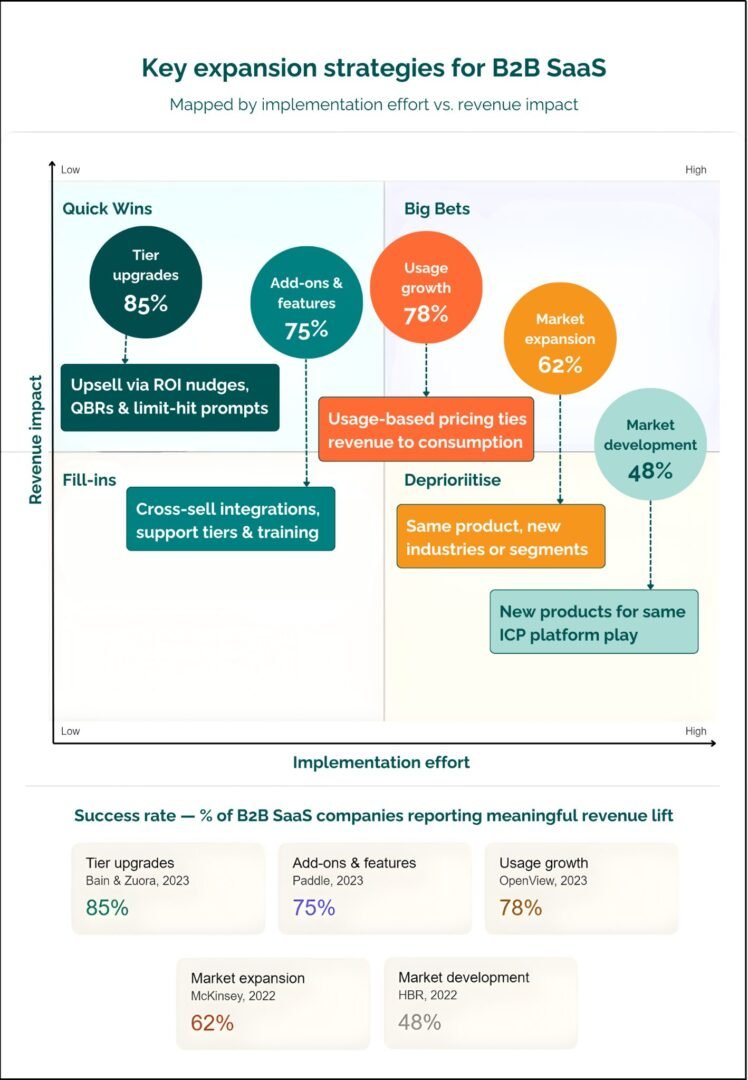
Expansion covers two distinct movements: upsell, where a customer moves to a higher tier or larger seat count, and cross-sell, where they adopt an adjacent product or module. Both follow the same logic: proven value from the current plan and a use case that has grown beyond it.
What’s happening on the customer side
Expansion-ready customers show recognizable behavioral patterns. They’re hitting usage limits or feature gates repeatedly. Team members outside the original buyer group are requesting access. The initial use case has stretched organically: a team that bought your tool for one workflow is now pushing it across three.
Their intent is not to upgrade. Their intent is to solve a growing problem. The upgrade is the mechanism, not the goal. Frame expansion conversations around that distinction and the dynamic shifts from vendor pressure to genuine problem-solving.
The touchpoints that drive expansion
- In-app usage signals: limit warnings, feature gate nudges, seat utilization indicators
- Customer success outreach triggered by product usage data, not quota cycles
- Feature discovery emails for capabilities the customer approaches but hasn’t unlocked
- Product-led expansion through usage-based pricing triggers or freemium-to-paid gates
- Shared usage reports that show customers their own growth trajectory inside the product
Timing matters more than messaging here. An expansion conversation initiated when a customer hits 90% seat utilization lands differently than one opened because a quota cycle is closing. Customers recognize the difference, and it affects trust.
Metrics that define expansion performance
Track expansion MRR separately from new business MRR. That separation gives you a clear picture of how efficiently your existing base grows independent of new acquisition.
Product-qualified account (PQA) conversion rate measures how many accounts that trigger your expansion signals actually convert: a low rate points to a timing or messaging problem, not a product one.
Time from initial activation to first expansion event reveals whether your product-led expansion design is pulling customers forward or waiting on your sales team to push them.
NRR captures the combined output of expansion and retention, but isolating expansion MRR as a standalone metric shows whether the motion is consistently working or only firing on high-touch accounts.
Insight:
According to GetMonitizely, top SaaS companies achieve Net Revenue Retention above 120%, meaning expansion revenue significantly contributes to overall growth.
6. Advocacy Stage
Advocacy doesn’t emerge from satisfaction. It’s engineered from identity.
The gap between a satisfied customer and an active advocate is motivation. Satisfied customers stay quiet. Advocates recommend your product publicly because it strengthens their professional reputation. They look knowledgeable and reliable to their network when they point peers toward tools that actually deliver. Build your advocacy program around that mechanism, not just customer delight.
What advocates actually do
They act without prompting. They leave G2 reviews after product updates, not just after support interactions. They answer “what tool do you use for X?” questions on LinkedIn with specific, experience-backed recommendations. They join beta programs, refer colleagues organically, and bring nuanced product feedback nobody asked for. These behaviors signal identity-level commitment, not surface-level satisfaction.
Touchpoints that build advocates
- NPS surveys with a purpose-built follow-up flow for promoters, not just a thank-you page
- Case study and co-marketing programs that give advocates professional visibility
- Referral programs built around status, early access, or community recognition rather than cash alone
- User communities where customers build peer relationships around the product
- Beta and early-access tracks that make top users feel like product partners
Cash incentives generate short-term referral volume but rarely build habitual advocacy. Programs tied to community recognition and insider access produce sustained, repeatable advocacy that compounds over time.
How to measure advocacy accurately
Track NPS promoter activation rate alongside raw NPS score. Of all 9 and 10 scorers, what percentage actually take a public advocacy action? That gap reveals where your advocacy program stalls. Also track referral-to-close rate separately from referral volume: high volume with low close rates signals low-quality referrals, not advocacy health. Monitor G2 and Capterra rating trends quarterly, community participation rates, and case study pipeline as a leading indicator of customer pride in the product.
Advocacy ROI compounds through reduced CAC, higher inbound close rates, and faster sales cycles for referred prospects. Correlate branded search volume growth with advocacy campaign periods. The compounding effect becomes visible within two to three quarters.
Insight:
According to Rivo, 92% of consumers trust recommendations from people they know over any other form of advertising, making referrals one of the most effective acquisition channels.
Why is Customer Journey Mapping Important for SaaS Companies?
Most SaaS growth issues do not come from acquisition. They come from users failing to progress through the lifecycle. Users sign up but do not activate, activate but do not retain, or retain without expanding.
Customer journey mapping helps you identify exactly where this breakdown happens and what is causing it. Instead of looking at SaaS metrics in isolation, it connects user behavior across stages into one system.
A simple way to understand this is through the SaaS lifecycle framework:
Acquisition → Activation → Retention → Expansion → Advocacy
Each stage builds on the previous one. If users do not reach value early, retention drops. If retention is weak, expansion does not happen. This creates compounding inefficiencies across growth.
Journey mapping gives you visibility into:
- Where users drop off across stages
- Which actions drive progression
- How product experience impacts revenue outcomes
This allows you to diagnose problems at the source instead of reacting to surface-level metrics like churn or low conversions.
In SaaS, growth comes from improving how users move through this lifecycle, not just increasing the number of users entering it.
How to Build Your SaaS Customer Journey Map (Step-by-Step)
Creating a SaaS customer journey map is not just about plotting stages; it’s about understanding how users actually experience your product at every step.
When done right, it helps you spot gaps, improve user experience, and drive long-term retention.
Let’s break it down into seven simple, actionable steps:
1. Have a Clear Purpose
Start with a clear goal before you build your journey map.
Ask yourself:
- What do you want to improve? (onboarding, retention, conversions)
- Which part of the journey needs attention?
- Are you focusing on new users or existing customers?
Without a clear purpose, your map can become too broad and difficult to act on.
You should define what you want to improve: onboarding, retention, or conversions, before creating your journey map.
2. Define Every Buyer Type
Not all users behave the same way. A startup founder, a marketing manager, and a developer will all interact differently with your SaaS product.
Create clear buyer personas by identifying:
- Their goals
- Pain points
- Use cases
- Decision triggers
This helps you build a more realistic journey instead of a generic one.
Use real customer data (CRM, surveys, support chats) instead of assumptions.
3. Establish the Stages of Your Customer Journey
Now outline the key stages your users go through.
Typically, a SaaS journey includes:
- Awareness
- Consideration
- Adoption
- Retention
- Expansion
- Advocacy
This helps you align your teams and create a consistent experience across the journey.
4. Identify the Customer Touchpoints at Each Stage
Touchpoints are every interaction a user has with your brand.
These can include:
- Blog posts or ads (Awareness)
- Landing pages or demos (Consideration)
- Product onboarding (Adoption)
- Emails and support (Retention)
Mapping these touchpoints shows where users engage and where they drop off.
You should map all touchpoints to understand where users engage and where they drop off.

5. Highlight Customer Milestones
Milestones are key moments that move users forward in their journey.
Examples include:
- Signing up for a free trial
- Completing onboarding
- First successful action (like creating a project)
- Upgrading to a paid plan
Tracking these milestones helps you understand what success looks like for your users.
6. Make Your Map Cyclical
Different from traditional funnels, SaaS journeys are not linear; they repeat.
After renewal or expansion, users continue interacting with your product, exploring new features, and engaging with your brand.
That’s why your journey map should be cyclical, not a straight line.
Focus on retention loops; happy users often become repeat buyers and advocates.
7. Measure the Outcome of the Customer Journey
Finally, track performance to see if your journey is actually working.
Key metrics to monitor:
- Conversion rates
- Customer retention rate
- Churn rate
- Customer Lifetime Value (CLV)
- Feature adoption rates
Regularly analyzing these metrics helps you refine your journey and improve user experience over time.
By following these seven steps, you can build a SaaS customer journey map that’s not just visually appealing but actually useful.
Conclusion
Building a strong SaaS customer journey is not just about mapping stages—it’s about improving how users experience your product at every step.
From the first interaction to long-term engagement, each stage plays a role in shaping how customers perceive and use your product.
When you focus on improving each stage of the journey, you can increase retention, reduce churn, and drive long-term growth.
The key is to keep refining your journey based on real user behavior, not assumptions.
Don’t treat your journey map as a one-time task. Keep refining it based on real user behavior and feedback to stay aligned with changing needs.
FAQ’s
1. What are common metrics used to measure the SaaS customer journey?
Common metrics include Customer Acquisition Cost (CAC), Customer Lifetime Value (CLV), retention rate, churn rate, activation rate, and feature adoption rate.
2. How often should a SaaS customer journey map be updated?
It should be updated every 3 to 6 months or whenever there are major changes like new features, pricing updates, or drops in user engagement.
3. What tools can help in mapping the SaaS customer journey?
Tools include product analytics platforms, heatmaps and session recordings, CRM systems, and survey tools.
4. How does personalization impact the SaaS customer journey?
Personalization improves the journey by delivering relevant experiences, increasing engagement, boosting product adoption, and improving retention.