


Enterprise SaaS sales involves selling high-value software through complex, multi-stakeholder buying processes.
It requires a structured approach, strong stakeholder alignment, and clear ROI to move deals forward.
This blog explains how the enterprise sales process works, key stages, proven strategies, common challenges, and the tools needed to close large deals effectively.
What is Enterprise SaaS Sales?
Enterprise SaaS sales is the process of selling subscription-based cloud software to large organizations through complex, multi-stakeholder buying cycles.
It involves structured B2B sales processes, long decision timelines, and alignment with the entire decision-making unit. Unlike traditional enterprise sales, it focuses on continuous value delivery through implementation, adoption, and usage.

How is Enterprise SaaS Sales Different from SMB SaaS Sales?
Enterprise and SMB SaaS sales differ significantly in terms of sales complexity, deal size, and the overall sales process.
This comparison highlights how enterprise SaaS sales require a more strategic, structured approach and often depend on sales-led SaaS growth strategies, while SMB sales focus on speed and scalability.
Here’s a clear comparison:
| Factor | Enterprise SaaS | SMB SaaS |
| Deal Size | $50K to $500K+ per year | $10 to $500 per month |
| Sales Cycle | 90 to 365 days | 1 to 14 days |
| Decision Makers | 6 to 12 people | 1 to 2 people |
| Sales Process Steps | 6 to 10 steps | 1 to 3 steps |
| Sales Motion | Sales-led model | Product-led or self-serve model |
| Customization | 60 to 90 percent tailored solution | 0 to 20 percent customization |
| Customer Acquisition Cost | $5K to $50K+ per customer | $10 to $500 per customer |
| Onboarding Time | 30 to 120 days | 1 to 7 days |
| Contract Length | 12 to 36 months | Monthly or 1 to 12 months |
| Churn Rate | 5 to 10 percent per year | 20 to 60 percent per year |
Who Buys Enterprise SaaS? (ICP & Stakeholders)
Enterprise SaaS is purchased by a group of stakeholders within large organizations, often called the decision-making unit (DMU) or buying committee. Each member plays a specific role in evaluating and approving the solution.
Key stakeholders involved in buying decisions:
- Economic buyer (decision-maker): Approves budget and evaluates ROI (e.g., CFO, VP)
- Technical buyer: Assesses integration, security, and technical fit (e.g., CTO, IT Head)
- End users: Evaluate usability and day-to-day workflow fit
- Champion: Drives internal support and influences the decision
- Procurement & legal: Handle contracts, pricing, and compliance
- Executive sponsor: Ensures alignment with business goals and final approval
Enterprise SaaS buying is a collaborative process where aligning the entire buying committee (DMU) is key to closing deals successfully.
What are the Key Stages of Enterprise SaaS Sales?
In enterprise SaaS, the sales process is not linear or quick. It typically follows a structured path influenced by multiple stakeholders, longer sales cycles, and higher contract values.
The enterprise sales process depends on consistency across every stage from initial outreach to long-term customer retention.
Below is a practical breakdown of each stage, with a focus on real execution.
1. Prospecting and Lead Generation
This stage focuses on identifying high-value target accounts that match your Ideal Customer Profile (ICP).
Instead of broad outreach, teams rely on account-based marketing (ABM), intent data, and firmographic segmentation.
Sales teams typically:
- Identify companies based on industry, revenue, and technology stack
- Track buyer intent signals like hiring trends or product gaps
- Build targeted lists for key decision-makers and economic buyers
Teams that want a structured approach to this can follow a dedicated ABM for SaaS framework to coordinate targeting, messaging, and outreach across the buying committee. The goal is to improve lead quality and pipeline efficiency, not just increase volume.
2. Needs Assessment
Once a prospect engages, the focus shifts to deep discovery and understanding business requirements. This stage is critical for aligning the solution with real outcomes.
Sales teams typically conduct in-depth discovery conversations and business analysis activities such as:
- Identify pain points and use cases
- Map key stakeholders and decision-makers
- Evaluate current systems and gaps
- Qualify deals using MEDDIC or BANT
A strong needs assessment improves solution fit and reduces friction later in the sales funnel.

3. Solution Presentation
At this stage, the product is positioned through a customized product demo or solution walkthrough. The focus is on relevance, not generic features.
Key elements of an effective solution presentation include:
- Customized demos aligned with use-case scenarios
- Mapping features to business outcomes and ROI
- Demonstrating scalability and enterprise integration capabilities
This stage directly impacts buyer confidence and internal alignment among stakeholders.
4. Proposal and Quoting
This stage formalizes the deal with a detailed sales proposal and pricing model. Enterprise deals often involve custom pricing, subscription models, or usage-based billing.
Enterprise SaaS companies often rely on custom contracts and value-based pricing models to align pricing with customer outcomes and long-term business impact.
Sales teams typically prepare and structure deal documentation activities such as:
- Create tailored proposals based on scope and requirements
- Define pricing structures, contract duration, and deliverables
- Include SLAs (Service Level Agreements) and implementation plans
Clarity here helps streamline procurement processes and reduces back-and-forth later.
5. Negotiation
Negotiation involves aligning on commercial terms, legal agreements, and risk factors. This stage often includes procurement, legal, and finance teams.
Key focus areas during enterprise deal negotiation and stakeholder alignment include:
- Pricing adjustments, discounts, and contract terms
- Security, compliance, and data protection requirements
- Finalizing SLAs and performance commitments
Strong negotiation ensures a balanced deal while protecting deal value and margins.
6. Closing the Deal
Closing is where all approvals are finalized and contracts are signed. In enterprise SaaS, this often involves multiple internal checkpoints and formal deal approvals.
Sales teams typically coordinate final deal validation and approval activities, such as:
- Objections are resolved and stakeholders are aligned
- Internal and external approvals are completed
- Contracts are signed and entered into the sales pipeline system
A smooth closing reflects strong execution across the entire sales cycle.
7. Onboarding and Implementation
After closing, the focus shifts to customer onboarding and solution deployment. This is a critical stage for delivering early value.
Typical activities involved in onboarding, system setup, and successful product adoption include:
- Product setup, configuration, and system integration
- Data migration and workflow alignment
- Training sessions for end-users and stakeholders
Effective onboarding improves time-to-value (TTV) and reduces early churn risk.
8. Customer Success and Support
This stage ensures continuous value delivery through customer success management and proactive support.
Key focus areas for maintaining customer value, engagement, and account growth include:
- Monitoring product adoption metrics and usage trends
- Providing ongoing support and optimization
- Identifying upsell and cross-sell opportunities
Strong customer success drives customer lifetime value (CLV) and long-term relationships.
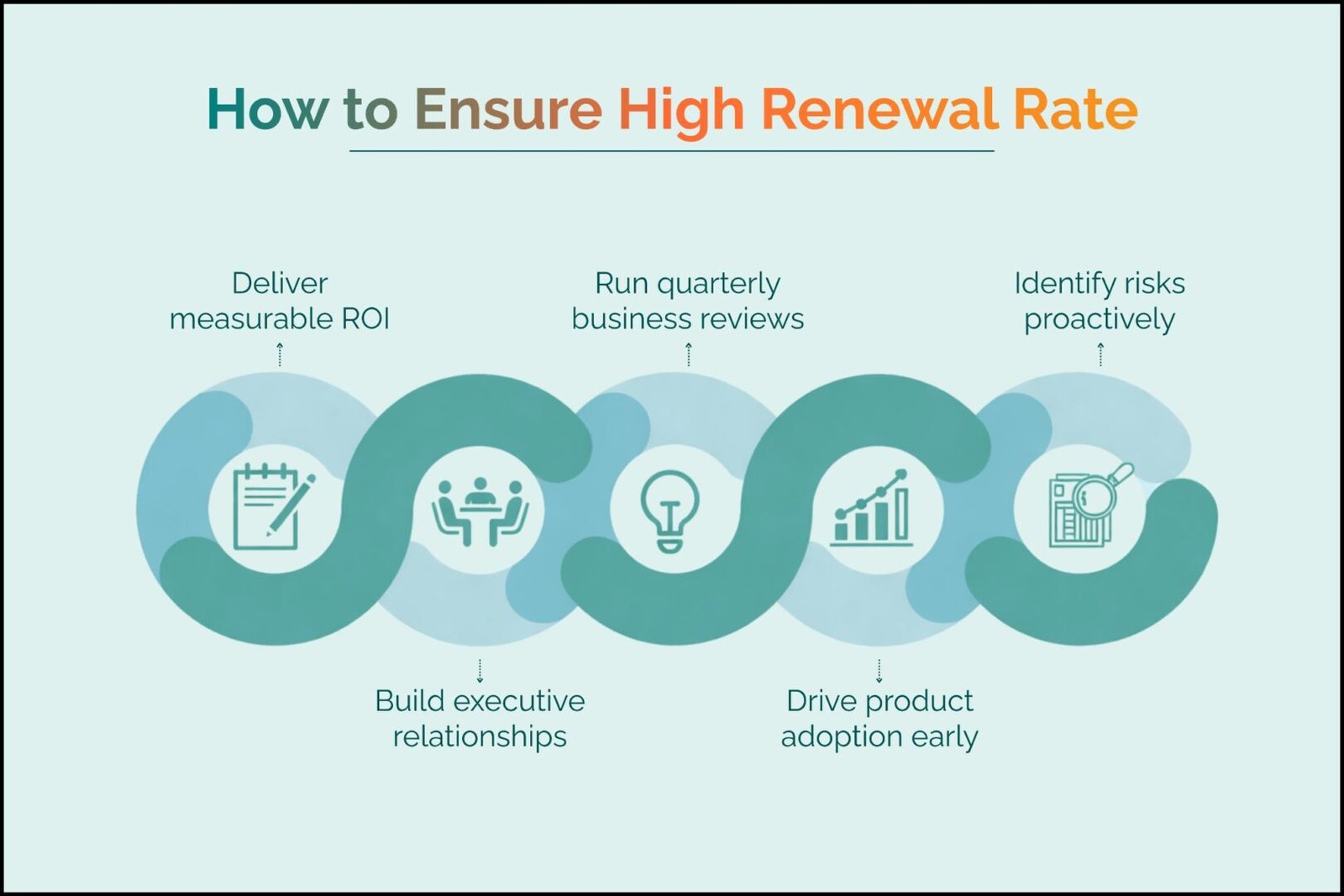
9. Renewal
Renewal is critical for maintaining recurring revenue and improving retention rates. It depends on the value delivered throughout the contract lifecycle.
Key focus areas for securing renewals and expanding enterprise accounts include:
- Demonstrate ROI using performance metrics and reports
- Address concerns before contract renewal timelines
- Expand contracts through account expansion strategies
High renewal rates are a result of consistent value delivery across the entire enterprise sales lifecycle.
Which Strategies Work Best in Enterprise SaaS Sales?
High-performing enterprise teams focus on strategies that improve deal quality, stakeholder alignment, and measurable business impact, rather than just increasing pipeline volume.
Below are the strategies that consistently work in real enterprise sales environments.
1. Account-Based Selling (ABS)
Account-Based Selling works best for high-value deals with long cycles and multiple stakeholders. It is not suited for low-ticket or high-volume sales.
Instead of filling the pipeline with weak leads, ABS targets accounts that fit your Ideal Customer Profile and show real buying intent. This improves conversion and resource efficiency.
What works in practice:
- Prioritize accounts based on ICP fit and revenue potential
- Use intent and firmographic data to identify the right timing
- Align sales and marketing around the same accounts
Tight alignment between sales and marketing is critical. When both teams focus on the same targets with consistent messaging, engagement improves.
Insight:
According to ITSMA, 87% of marketers say account-based marketing delivers higher ROI than any other marketing approach.
2. Relationship-driven selling
Enterprise deals involve multiple stakeholders and high risk. Buyers are not just choosing a product. They are choosing a partner.
This approach matters most in mid to late stages, where trust determines whether deals move forward.
Deals rarely fail due to missing features. They fail when stakeholders lack confidence.
What works in practice:
- Engage decision-makers, influencers, and champions early
- Maintain consistent and relevant communication
- Focus on business goals, not product features
The shift is simple. Stop selling. Start advising.
Trust is not optional in enterprise sales. It directly drives conversion.
Insight:
According to Gartner, B2B buyers spend only 17% of their buying journey meeting with suppliers, which means trust must be built quickly and effectively.
3. Multi-threading across teams
Enterprise decisions come from groups, not individuals. Relying on a single contact puts the deal at risk.
If that person loses influence or leaves, the deal often collapses.
What works in practice:
- Engage multiple stakeholders early
- Build relationships across technical, financial, and executive teams
- Tailor messaging to each role
You should map the decision-making unit early, identify champions and blockers, and manage them actively.
Single-threaded deals are fragile. Strong deals have multiple connections.
Insight:
According to Gartner, the average B2B buying group involves 6 to 10 decision-makers, each bringing different perspectives and concerns.
4. Value-based selling (ROI focus)
Enterprise buyers care about outcomes, not features. They need clear business impact to justify investment.
If you cannot quantify value, you lose to someone who can.
What works in practice:
- Show ROI through cost savings, revenue growth, or efficiency gains
- Connect product capabilities to business outcomes
- Use data and case studies to support your claims
Most teams describe features. Top teams translate those features into results.
If ROI is missing, the pitch will not land.
Insight:
According to Forrester, 74% of B2B buyers choose the vendor that demonstrates clear business value and ROI.
5. Personalization at scale
Enterprise buyers expect relevance. Generic outreach signals poor understanding and gets ignored.
Personalization works when you combine context with efficiency.
What works in practice:
- Tailor messaging by industry and role
- Use account data to shape outreach
- Align content with specific use cases
This is not about inserting a company name into an email. It is about demonstrating real understanding of the buyer’s situation.
Relevance drives engagement. Even small improvements in personalization can make a measurable difference.
Insights:
According to McKinsey, personalization can increase revenue by 10% to 15% and improve marketing efficiency.

What are the Common Challenges in Enterprise SaaS Sales?
Enterprise SaaS sales are complex. Long cycles, multiple stakeholders, and structured processes make it difficult to move deals forward without a clear strategy.
These are the most common challenges:
1. Long and Unpredictable Sales Cycles
Enterprise deals often take months to close. Approvals, legal reviews, and internal evaluations slow progress.
This makes revenue forecasting difficult and weakens pipeline predictability.
2. Multiple Stakeholders and Decision-Makers
Enterprise deals involve stakeholders across IT, finance, and leadership. Each group has different priorities.
Sales teams must align these perspectives to move the deal forward.
3. Complex Procurement and Approval Processes
Large organizations follow strict procurement workflows. These include compliance checks, vendor reviews, and legal approvals.
Each step adds friction and extends the timeline.
4. Difficulty Demonstrating Clear ROI
Enterprise buyers expect measurable outcomes before committing to large investments.
Sales teams must prove ROI, business impact, and long-term value to justify the cost.
5. High Competition and Vendor Comparison
Buyers evaluate multiple vendors before making a decision.
To stand out, you need a strong value proposition, clear proof points, and tailored messaging.
6. Managing Custom Requirements and Integrations
Enterprise clients often require customization, integrations, and scalability.
Addressing technical requirements and feasibility can slow deal progress.
7. Internal Alignment Across Teams
Misalignment between sales, marketing, and product leads to inconsistent messaging.
Strong alignment improves go-to-market execution and conversion rates.
8. Maintaining Momentum Throughout the Sales Funnel
Long cycles make it hard to keep prospects engaged.
Consistent follow-ups, relevant communication, and timely touchpoints are essential to maintain momentum.
What are the Pros and Cons of Selling SaaS to Enterprises?
Selling to enterprise clients can drive significant growth, but it also comes with added complexity.
Below is a clear comparison to help understand both sides of the enterprise SaaS sales model:
| Pros of Enterprise SaaS Sales | Cons of Enterprise SaaS Sales |
| Higher contract value (ACV) leading to increased revenue per deal | Longer sales cycles can delay revenue realization |
| Strong customer lifetime value (CLV) due to long-term contracts | Complex decision-making processes with multiple stakeholders |
| More predictable recurring revenue through multi-year agreements | Lengthy procurement and approval processes |
| Opportunity for upselling and cross-selling within large accounts | High expectations for customization and integrations |
| Builds strong brand credibility by working with enterprise clients | Requires significant sales effort and resources |
| Better account expansion opportunities across departments | Difficult stakeholder alignment across teams |
| Access to larger budgets and strategic partnerships | Intense vendor competition and comparison |
| Improved retention rates with successful onboarding and support | Greater pressure to demonstrate clear ROI and business impact |
Which Tools are Used in Enterprise SaaS Sales?
Enterprise sales teams rely on a focused tech stack to manage pipelines, improve visibility, and streamline execution across the sales cycle.
These tools support prospecting, deal management, and retention:
1. CRM Tools
CRM platforms act as the system of record for sales.
What they enable:
- Manage the sales pipeline
- Track interactions and deal stages
- Forecast revenue
Examples: Salesforce, HubSpot
2. Sales Intelligence Tools
These tools help teams identify target accounts and understand buying intent.
What they enable:
- Find decision-makers and target companies
- Enrich lead and account data
- Support account-based selling
Examples: ZoomInfo, Apollo.io
3. Sales Engagement Tools
Sales engagement platforms manage outreach and communication at scale.
What they enable:
- Run email sequences and follow-ups
- Track engagement metrics
- Coordinate multi-channel outreach
Examples: Outreach, Salesloft
4. CPQ and Proposal Tools
These tools simplify pricing, quoting, and contract workflows.
What they enable:
- Generate accurate quotes
- Manage approvals and contracts
- Reduce pricing and configuration errors
Examples: DealHub, PandaDoc
5. Communication Tools
Communication platforms support both internal alignment and client interaction.
What they enable:
- Team collaboration
- Meetings and updates
- Document sharing
Examples: Slack, Microsoft Teams
6. Analytics and RevOps Tools
These tools provide visibility into performance and pipeline health.
What they enable:
- Track pipeline coverage
- Measure win rates
- Identify deal slippage
- Monitor sales velocity
- Forecast revenue
- Spot bottlenecks
Examples: Clari, Gong
Final Thoughts
Enterprise SaaS sales requires a structured and repeatable process. Teams must handle long cycles, multiple stakeholders, and high-value contracts with discipline.
Success depends on execution across every stage, from qualification to retention.
Teams that align around clear strategies, maintain strong internal coordination, and use the right tools close deals faster and more consistently.
Focus on business value. That is what drives enterprise decisions.
FAQs
1. What is the typical sales cycle for enterprise SaaS?
The sales cycle usually ranges from 3 to 12 months. It depends on deal size, industry, and decision complexity. Larger deals take longer due to multiple stakeholders, procurement steps, and legal approvals.
2. Why are enterprise SaaS sales more complex than SMB sales?
Enterprise sales involve more stakeholders, longer approval processes, and higher contract values. Teams must manage stakeholder alignment, compliance requirements, and detailed vendor evaluations. This adds layers of complexity compared to SMB sales.
3. What is account-based selling in enterprise SaaS?
Account-Based Selling focuses on a defined set of high-value accounts instead of broad lead generation. Teams use personalized outreach, targeted marketing, and tailored messaging to engage key stakeholders within each account.
4. What skills are essential for success in enterprise SaaS sales?
Key skills include stakeholder management, consultative selling, and clear communication. Sales professionals must also handle complex negotiations, understand business needs, and demonstrate ROI and business impact.
5. How do you shorten the enterprise SaaS sales cycle?
Focus on strong qualification, early stakeholder mapping, and clear ROI communication. Consistent follow-ups, aligned messaging, and effective use of sales tools help improve deal velocity.