B2B SaaS content writing has become one of the most effective ways to drive organic traffic, qualified leads, and long-term growth. But simply publishing blogs or landing pages isn’t enough.
To build a real impact, SaaS companies need a structured, search-driven content strategy that aligns with user intent, product value, and the buyer journey.
In this guide, you’ll learn how to build a scalable B2B SaaS content engine from understanding fundamentals like search intent and ICPs to creating high-performing content formats, optimizing for conversions, and avoiding common mistakes.
What is B2B SaaS Content Writing?
B2B SaaS content writing is the process of creating strategic, SEO-driven, and product-focused content that helps businesses understand, evaluate, and adopt a software solution.
This type of content goes beyond just attracting traffic. It focuses on educating decision-makers, solving real business problems, and naturally positioning your product as the right solution.
B2B SaaS Content Writing vs. “Normal” Content Writing
Below are the key differences between B2B SaaS content writing and “normal” content writing based on strategy, SEO approach, audience targeting, and business impact:
| Aspect | B2B SaaS Content Writing | Normal Content Writing |
|---|---|---|
| Primary Goal | Drive lead generation, product adoption, and revenue growth | Focus on general awareness, engagement, or traffic |
| Target Audience | Specific ICPs such as founders, marketers, product teams, and decision-makers | Broad or undefined audience segments |
| Search Intent Focus | Strong alignment with informational, commercial, and transactional intent | Often focuses mainly on informational intent |
| Content Strategy | Built around SEO, funnel stages, and buyer journey mapping | Less structured and often topic-based |
| Product Integration | Includes product-led content and solution-driven messaging | Minimal or no product connection |
| Content Depth | Highly detailed with use cases, workflows, and data-driven insights | Can be surface-level or general |
| Sales Alignment | Closely tied to the sales funnel, conversions, and CRO | Limited connection to sales outcomes |
| Content Types | Includes case studies, comparison pages, landing pages, and product content | Mostly blogs, articles, or general content |
| Buying Cycle Consideration | Accounts for long and complex B2B buying cycles | Usually shorter or simpler buying cycles |
What Should You Know Before Starting B2B SaaS Content Writing?
Before you start writing, you need a strong foundation. Most SaaS content fails not because of poor writing, but because the strategy behind it is weak.
This section covers the key things you should get right before creating any B2B SaaS content.
1. Search Intent
Search intent is the reason behind a user’s query. If your content doesn’t match it, it won’t rank or convert.
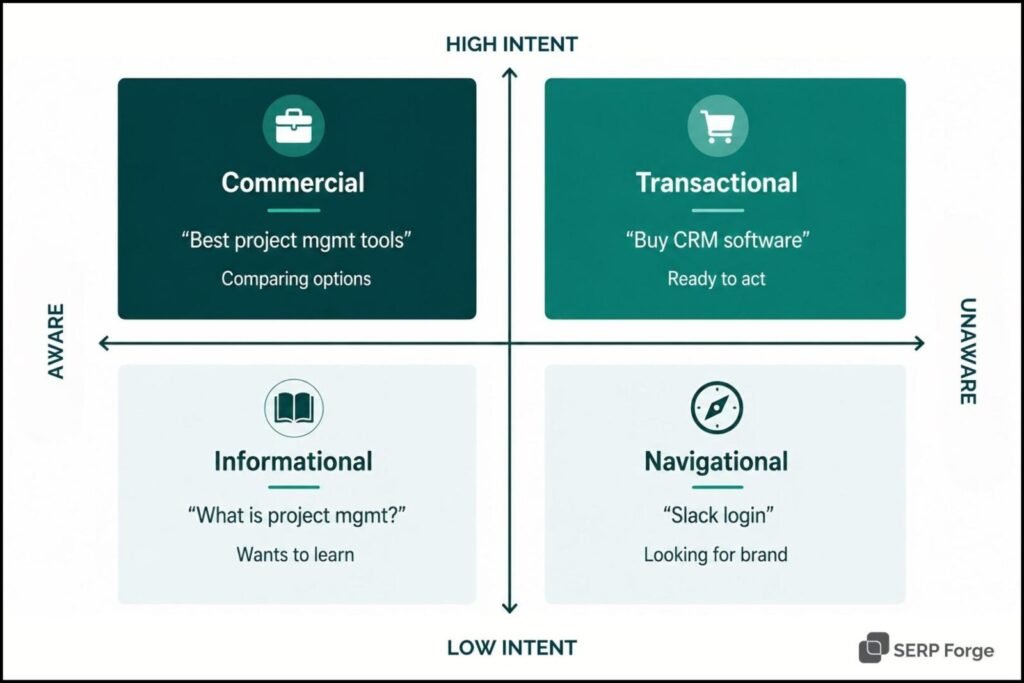
There are four main types of intent:
- Informational: Users want to learn something
Example: “What is project management software?” - Navigational: Users are looking for a specific brand or page
Example: “Slack login” - Commercial: Users are comparing options
Example: “Best project management tools” - Transactional: Users are ready to take action
Example: “Buy CRM software”
To get this right:
- Check the top-ranking pages for your keyword
- Identify what type of content is ranking
- Match your format to the intent
If Google shows mostly listicles, don’t create a product page. Match what already works, then improve it.
2. SERP Analysis
SERP (Search Engine Results Page) analysis helps you understand what Google is rewarding for a keyword.
Instead of guessing, you study what’s already ranking and use that as a benchmark.
Here’s what to look at:
- Content format: Blogs, landing pages, comparison pages
- Content depth: Word count, sections covered
- Headings structure: How topics are organized
- Use of visuals: Images, charts, tables
- Featured snippets: Quick answers at the top
Once you analyze this, ask:
- What are competitors missing?
- Can you add better examples or data?
- Can you simplify the explanation?
Don’t just copy top results, find gaps and create something more useful.
3. Know Your Targeted ICPs
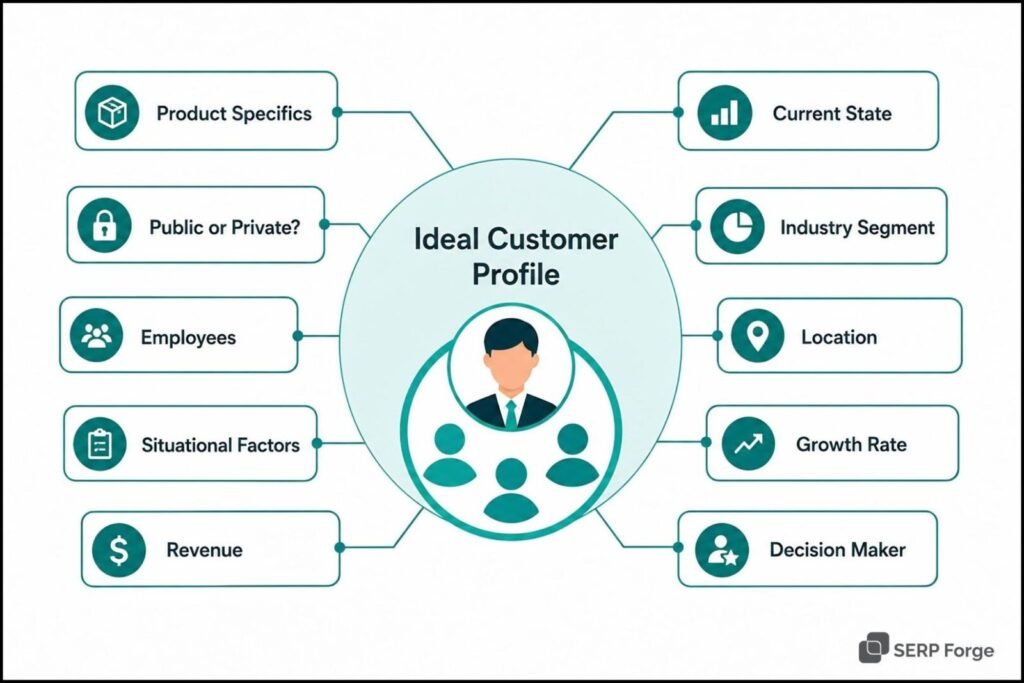
ICP (Ideal Customer Profile) defines who your content is actually for.
In SaaS, you’re rarely writing for “everyone.” You’re targeting specific roles like:
- Founders
- Marketing managers
- Product teams
- Sales leaders
Each of them:
- Faces different challenges
- Uses different tools
- Has different priorities
To build a clear ICP, understand:
- Industry and company size
- Key problems they want to solve
- Buying triggers
- Objections they might have
One piece of content = one primary ICP. Trying to target everyone makes your message weak.
4. Deep Product Understanding
You can’t create high-performing B2B SaaS content without a deep understanding of the product.
Surface-level knowledge leads to generic writing, while strong product understanding enables product-led content, better positioning, and higher conversions.
Focus on understanding:
- Core features, functionality, and product capabilities
- Real-world use cases and customer workflows
- Unique differentiators and competitive positioning
- Limitations and edge cases (which build trust and credibility)
Ask key questions like:
- What problem does the product solve better than competitors?
- Which use cases deliver the highest ROI or impact?
- When is this product not the right fit?
- What measurable outcomes can users expect?
Strong product understanding improves content by:
- Adding real examples and practical insights
- Enabling natural product integration within content
- Strengthening conversion-focused messaging and positioning
Spend time using the product, reviewing demos, or speaking with product and sales teams. This improves content accuracy, depth, and conversion potential significantly.
Which B2B SaaS Content Formats Drive the Best Results?
Not all content formats deliver the same results in B2B SaaS: some drive organic traffic, others generate leads, and a few directly impact conversions and pipeline revenue.
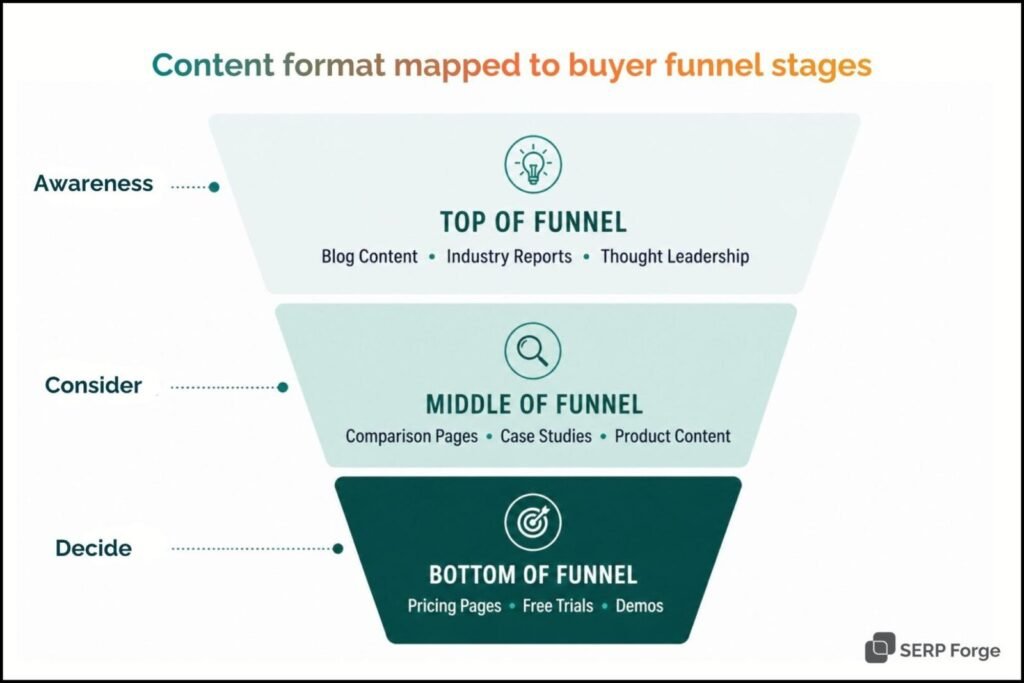
A strong strategy uses a mix of formats aligned with each stage of the buyer journey (awareness to decision).
1. Landing Pages
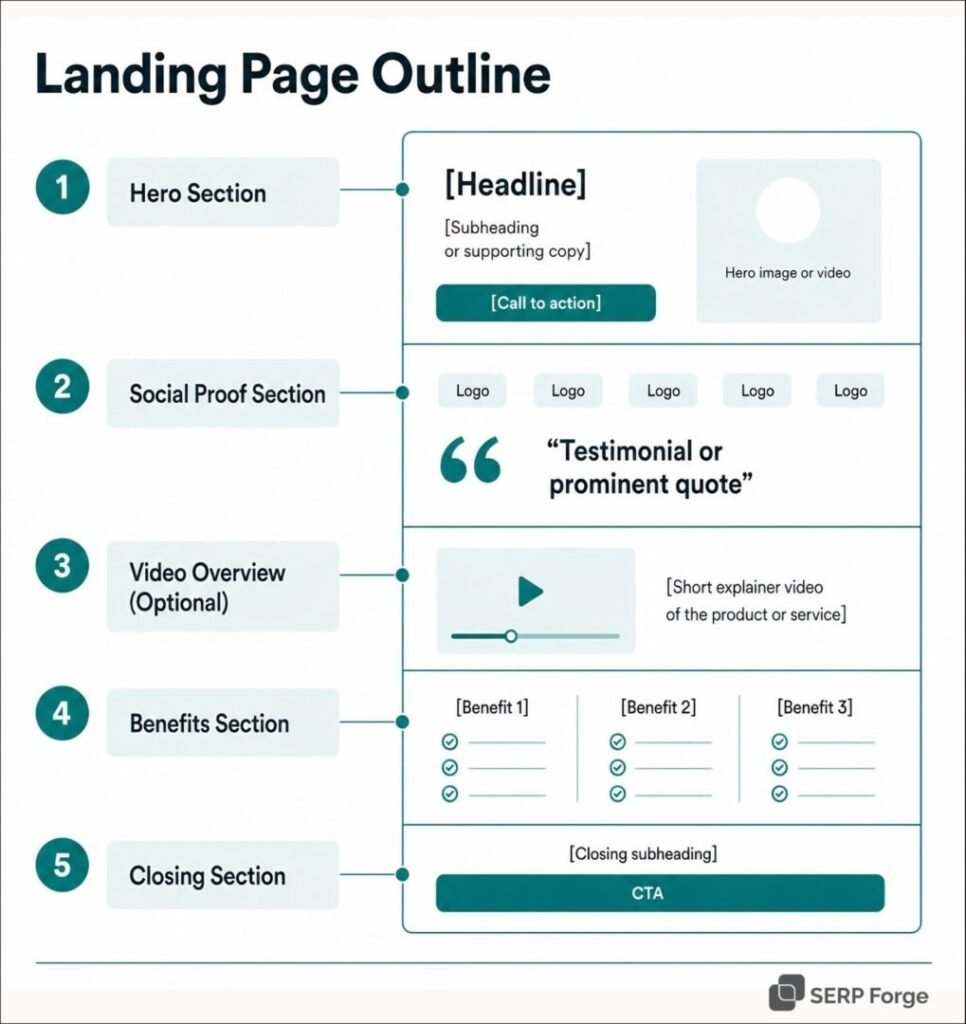
Landing pages are designed for high-conversion actions like demo bookings, free trials, or sign-ups.
They typically target bottom-of-funnel (BoFu) keywords such as:
- “CRM software for startups”
- “best marketing automation tool”
- “email automation platform pricing”
Key elements of high-performing SaaS landing pages:
- Clear value proposition with benefit-driven messaging
- Focus on customer pain points and solutions
- Strong and visible call-to-action (CTA)
- Trust signals like customer testimonials, case proof, and client logos
- Conversion-focused layout with minimal distractions
These pages play a critical role in SaaS lead generation and improving conversion optimization (CRO).
Align your landing page copy with search intent + product positioning to improve both rankings and conversions.
2. Blog Content
Blog content is the backbone of SaaS SEO and inbound marketing.
It helps you:
- Rank for informational and commercial keywords
- Build topical authority in your niche
- Educate potential buyers early in their journey
To perform well, blog content should:
- Target long-tail keywords and low-competition queries
- Be optimized for on-page SEO (headings, internal links, readability)
- Provide real value through examples, frameworks, or use cases
Blog content supports top-of-funnel (ToFu) and middle-of-funnel (MoFu) growth while feeding users into your product ecosystem.
Combine SEO content + product-led insights to turn traffic into qualified leads.
According to HubSpot, businesses that actively publish blogs generate 55% more website visitors compared to those that don’t, making it one of the most effective ways to attract new prospects
3. Industry Reports / Data Studies
Industry reports and data studies are powerful for building authority, backlinks, and brand credibility.
This format includes:
- Original research
- SaaS benchmarks
- Survey-based insights
- Market trend analysis
Why it works:
- Attracts high-quality backlinks (link building advantage)
- Positions your brand as an industry expert
- Supports digital PR and content distribution
It’s especially useful for improving:
- Domain authority
- Organic visibility
- Content differentiation in competitive niches
Data-driven SaaS content often earns significantly more referring domains than standard blog posts.
4. Case Studies
Case studies are one of the most effective formats for conversion-focused content.
They showcase real results and help build trust and credibility during the decision stage.
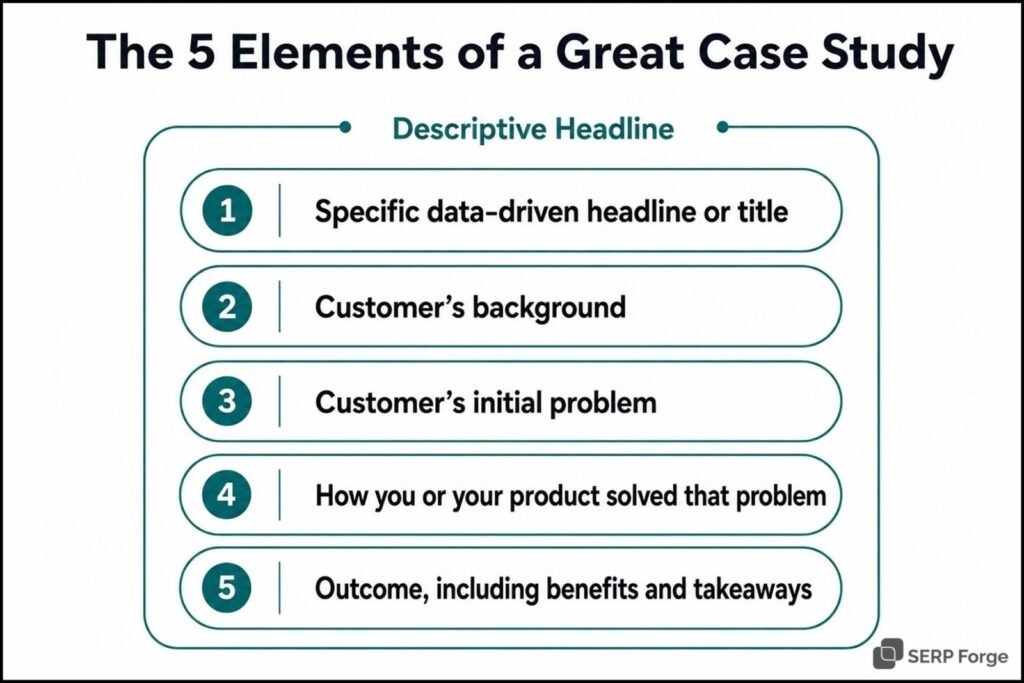
A strong SaaS case study includes:
- Customer background and problem statement
- Solution implementation using your product
- Measurable outcomes (ROI, revenue growth, efficiency gains)
- Clear storytelling with before-and-after impact
This format works best for:
- Bottom-of-funnel users
- Supporting sales enablement
- Improving conversion rates
Use specific metrics (e.g., “reduced churn by 25%”) to make your case studies more persuasive.
5. Comparison & Alternative Pages
Comparison and alternative pages target high-intent commercial keywords.
Examples:
- “HubSpot vs Salesforce”
- “Best alternatives to Mailchimp”
- “Top CRM tools comparison”
These users are already evaluating solutions, making this format ideal for:
- Product-led SEO
- Capturing buyer-intent traffic
- Driving qualified leads
To make these pages effective:
- Provide clear, structured comparisons (features, pricing, use cases)
- Maintain neutral and honest positioning
- Highlight your product’s strengths without being overly biased
- Optimize for commercial search intent and conversion keywords
These pages directly influence purchase decisions and are key to SaaS funnel optimization.
Transparent comparisons build more trust and often outperform overly promotional content in conversion rate optimization (CRO).
What Types of B2B SaaS Content Should You Focus On?
Most SaaS teams create content, but few build a system that drives organic traffic, qualified leads, and revenue.
The difference comes from choosing the right content mix and aligning it with search intent, buyer journey stages, and product positioning.
1. SEO Content
SEO content is the backbone of organic growth and inbound marketing. It focuses on capturing users through search engines by targeting relevant keywords, long-tail queries, and intent-driven topics.
Key areas to focus on in SEO content include:
- Intent-driven keyword targeting instead of just high search volume
- Strong on-page SEO elements like headings, internal links, and structure
- Deep content coverage with semantic and LSI keywords
- Targeting long-tail and low-competition queries for faster wins
SEO content performs best when it aligns problem + intent + clear solution, not just keywords.
2. Product-Led Content
Product-led content connects your SaaS product with real user workflows, blending education with practical use cases. It helps users see outcomes clearly, reduces friction, and supports product-led growth (PLG) and activation.
Important elements to focus on in product-led content include:
- Real use cases that show practical implementation
- Step-by-step workflows using your product
- Feature-focused tutorials tied to outcomes
- Integration-based content that shows ecosystem value
Users don’t care about features; they care about the results those features deliver.
3. Data-Driven Content
Data-driven content gives an edge with original insights from research or data. It builds authority, trust, and backlinks, improving rankings while positioning your brand as a knowledge leader.
Key focus areas in data-driven content include:
- Original research, such as surveys and benchmark reports
- Industry trends and performance analysis
- Statistics-backed insights that support arguments
- Visual data representation for better readability and sharing
Data-driven content often becomes a long-term SEO asset by continuously attracting backlinks.
4. Pain-Point Content
Pain-point content starts with the user’s problem, focusing on specific challenges and inefficiencies. It attracts problem-aware users actively searching for solutions.
Important aspects to cover in pain-point content include:
- Clearly defined problems with real-world context
- Common mistakes or inefficiencies users face
- Root causes behind those challenges
- Practical ways to solve or improve the situation
The more specific and relatable the problem, the higher the engagement and conversion potential.
5. Thought Leadership Content
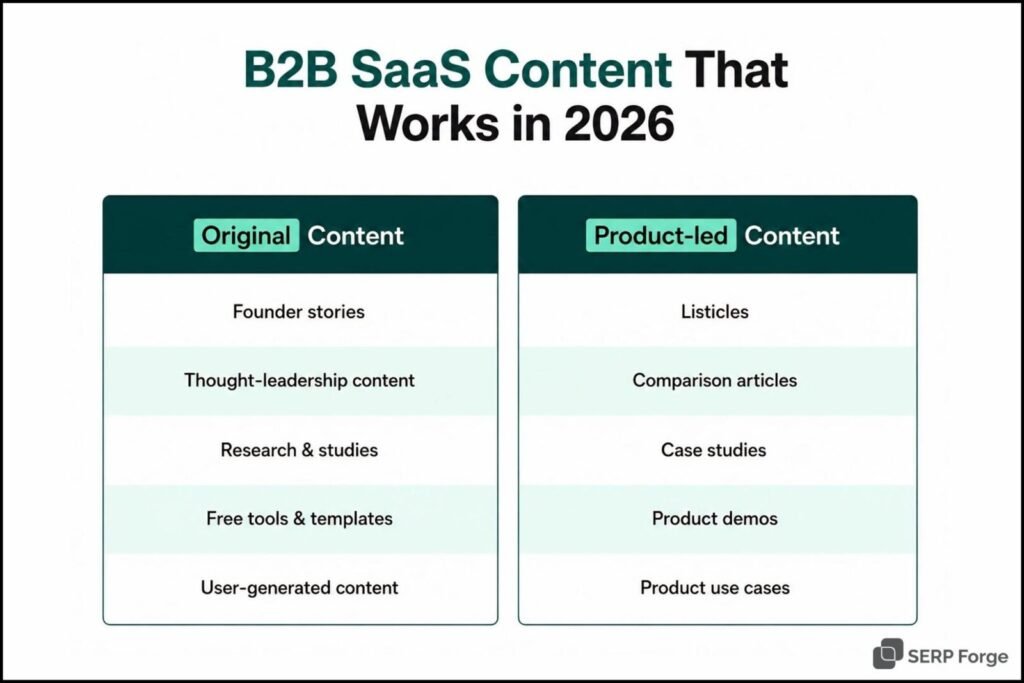
Thought leadership content helps your brand stand out by sharing original perspectives, insights, and strategic thinking. Instead of explaining basic concepts, it focuses on adding value through experience and expertise.
It also supports long-term brand positioning and recognition, making your company more memorable in a competitive market.
Key elements to focus on in thought leadership content include:
- Strong opinions supported by data or real experience
- Insights on emerging trends and industry shifts
- Strategic frameworks and decision-making approaches
- Unique viewpoints that differentiate your brand
Clear, confident perspectives make your content more impactful than neutral, generic advice.
6. Topical Authority Content
Topical authority content focuses on building depth around a subject instead of creating isolated pieces. It involves creating a cluster of interconnected content that fully covers a topic from multiple angles.
Over time, this leads to stronger search visibility and keyword dominance in your niche.
Key areas to focus on when building topical authority include:
- Creating pillar pages that cover broad topics
- Supporting them with detailed cluster content
- Interlinking pages strategically for better navigation
- Covering both basic and advanced subtopics
Owning a topic gives you a stronger advantage than ranking for a single keyword.
7. Conversion-Focused Content
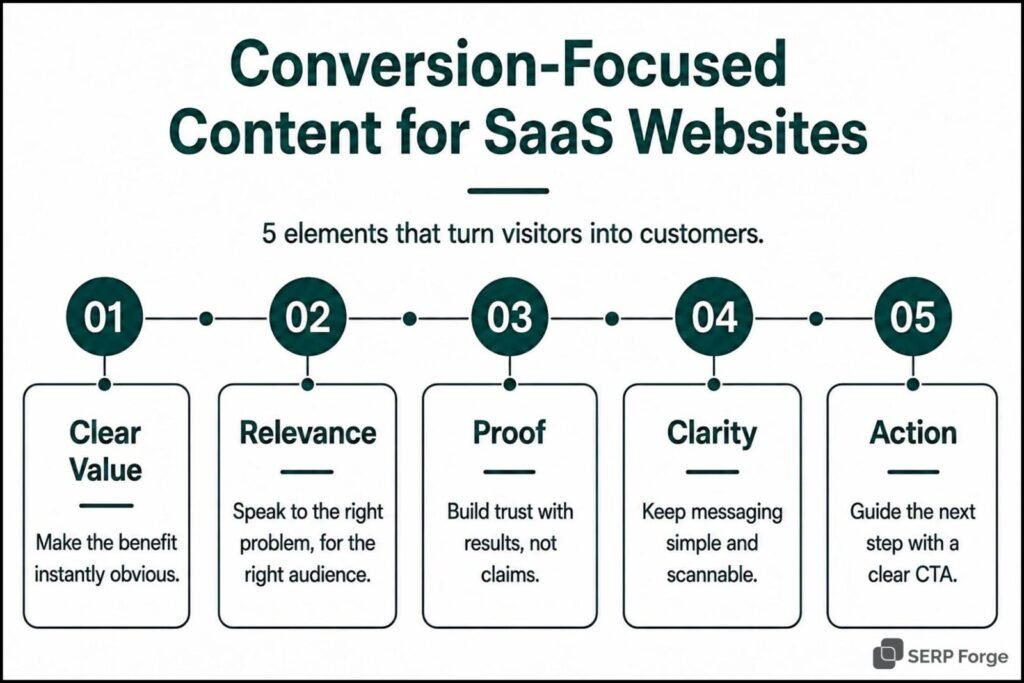
Conversion-focused content directly impacts revenue by targeting users close to decision-making. It includes landing pages, product pages, and comparison content optimized for commercial and transactional intent, focusing on clarity, persuasion, and action.
Key elements to focus on in conversion-focused content include:
- Clear value proposition aligned with user intent
- Benefit-driven messaging instead of feature-heavy explanations
- Strong and visible calls-to-action
- Social proof, such as testimonials, case studies, and metrics
- Product positioning that highlights differentiation
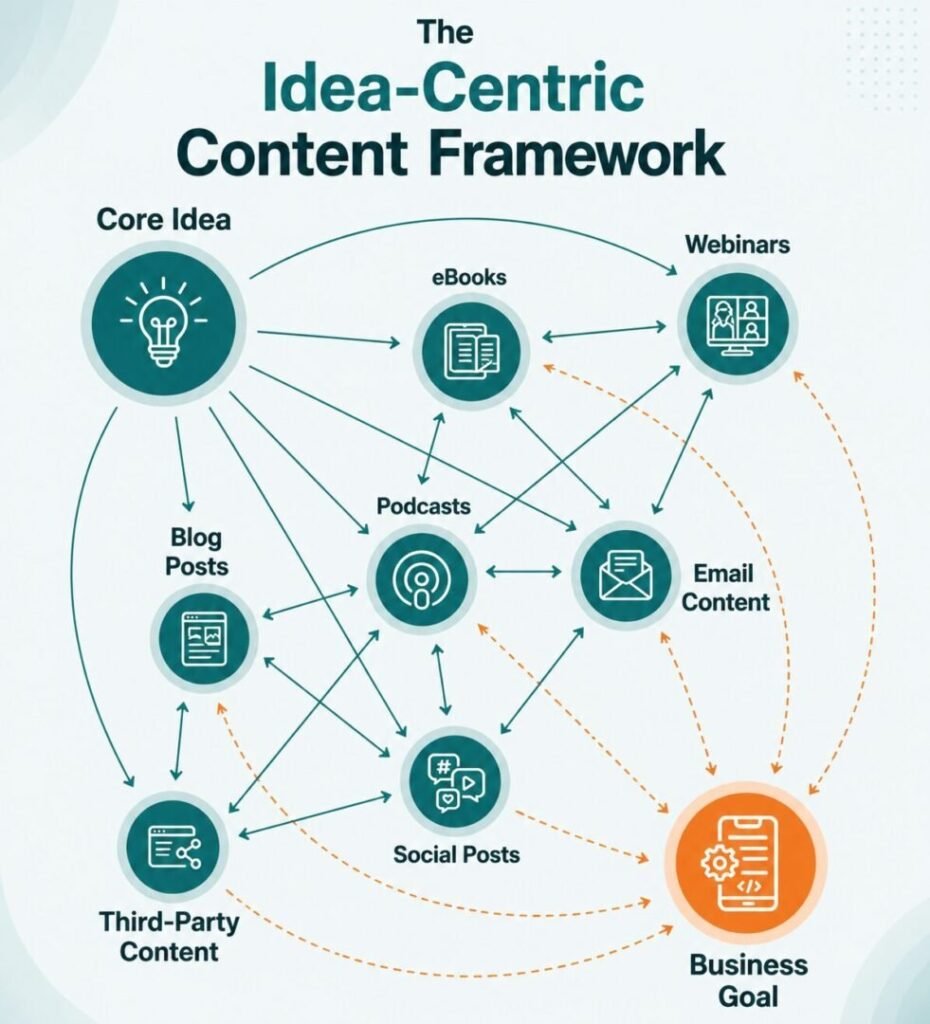
A high-performing SaaS content strategy combines these content types into a unified system.
What Are the Best Practices for B2B SaaS Content Writing?
SaaS content isn’t just writing, it’s building a system that drives organic traffic, engagement, leads, and conversions.
High-performing content aligns with search intent, structure, and product integration across the customer journey, delivering real SEO results and pipeline growth.
Write for Humans First, SEO Second
Many SaaS teams over-optimize search engines and forget the actual reader. However, modern SEO prioritizes user experience, helpful content, and content quality signals like engagement and dwell time.
Important aspects to focus on here include:
- Clear, simple language that avoids unnecessary jargon
- Logical content flow that improves readability and comprehension
- Content that solves real user problems and aligns with search intent
Strong user-focused content naturally improves SEO metrics like time on page and bounce rate.
Align Content with Funnel Stages
Not every visitor is ready to convert, some are exploring, others comparing or validating. That’s why aligning content with funnel stages (ToFu, MoFu, BoFu) is essential for better engagement and conversions.
Key considerations when aligning content with funnel stages include:
- Mapping keywords to intent (informational, commercial, transactional)
- Creating content for awareness, consideration, and decision stages
- Using stage-specific CTAs to guide users forward
This ensures your content supports the full SaaS sales funnel and buyer journey optimization.
Use Clear, Benefit-Driven Messaging
SaaS content often over-focuses on features, reducing clarity. Users care about outcomes, time savings, efficiency, and revenue growth. Benefit-driven messaging makes value clear and improves conversion performance.
Important elements to emphasize in benefit-driven messaging include:
- Clear value propositions tied to user outcomes
- Focus on ROI, efficiency, and measurable improvements
- Simple explanations that highlight real-world impact
Strong messaging improves both conversion rate optimization (CRO) and user engagement.
Integrate Product Naturally
Balancing education and promotion is key in SaaS content ignoring the product hurts conversions, while over-promoting reduces trust.
The goal is natural product integration, aligning with buyer intent and product-led growth (PLG).
Key areas to focus on for natural product integration include:
- Introducing the product in the right context within the content
- Using real-world use cases and workflows
- Connecting product features with specific pain points
This improves content-driven conversions and product adoption without disrupting the reading experience.
Leverage Social Proof and Data
Trust is critical in SaaS buying decisions, especially in competitive markets. Social proof and data provide validation, strengthening credibility, trust signals, and decision confidence.
Important elements to include for building trust include:
- Customer testimonials and user reviews
- Case studies with measurable results and ROI
- Data-backed insights and industry statistics
These elements support conversion optimization, brand trust, and sales enablement.
Optimize for Readability and Scannability
Most users scan content before reading it fully. If your content is hard to navigate, you risk losing engagement and increasing bounce rates.
Improving readability enhances user experience (UX), engagement metrics, and content performance across devices.
Key aspects to focus on for better readability include:
- Short paragraphs and clean formatting
- Clear headings and subheadings for structure
- Strategic use of bullet points and white space
- Simple sentence construction for clarity
Better readability improves dwell time, scroll depth, and SEO performance signals.
Continuously Update and Refresh Content
SaaS content requires ongoing optimization as search trends, competition, and product updates evolve. Regular refreshes help maintain keyword rankings, organic traffic, and content relevance.
Important areas to focus on when updating content include:
- Updating outdated data, statistics, and examples
- Adding new product features or use cases
- Improving internal linking and keyword targeting
- Re-optimizing for evolving search intent and SERP changes
Regular updates keep content competitive and support long-term SEO and growth marketing.
Following these best practices helps you align with search intent, user needs, and business goals, driving consistent traffic, better conversions, and a scalable content engine.
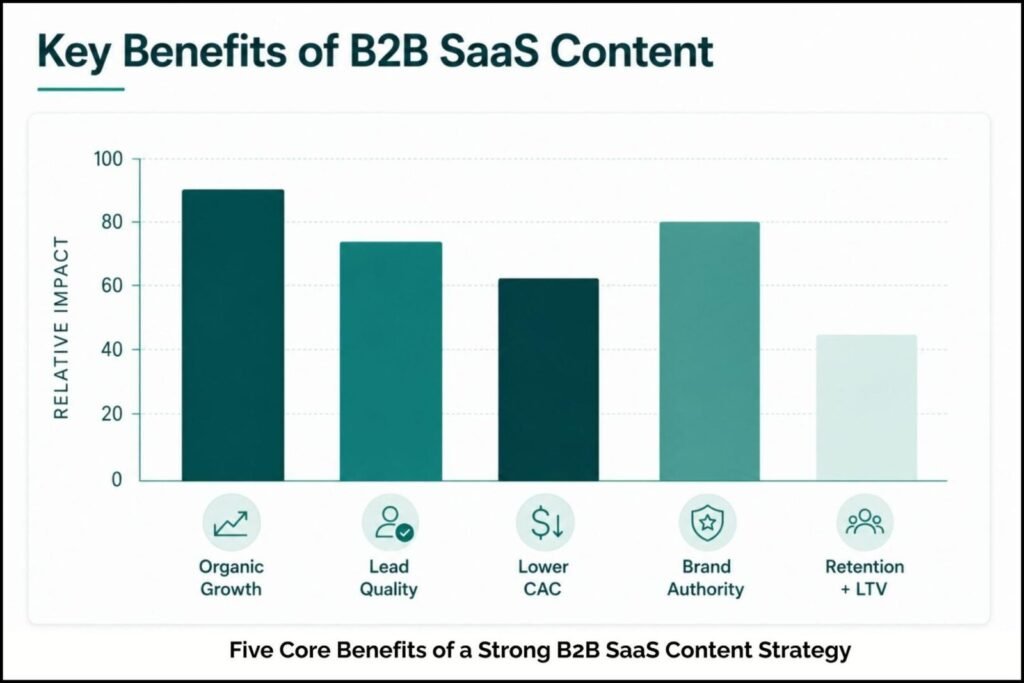
What Are the Key Benefits of B2B SaaS Content Writing?
B2B SaaS content writing drives organic growth, qualified leads, and long-term revenue.
When aligned with search intent, SEO strategy, and the buyer journey, it becomes a scalable channel for acquisition and retention.
Sustainable Organic Growth
SEO-focused content helps you generate consistent organic traffic without relying on paid ads. By targeting high-intent keywords, long-tail queries, and topic clusters, your content keeps bringing users over time.
This supports long-term growth by:
- Compounding traffic through improved keyword rankings and search visibility
- Strengthening domain authority and topical relevance
- Driving continuous inbound traffic without recurring ad spend
Higher-Quality Leads
Content attracts users who are already searching for solutions, making them more likely to convert. These are intent-driven, problem-aware users who enter your funnel with context.
This improves lead quality by:
- Bringing in users aligned with search intent and buyer needs
- Increasing conversion rates due to better awareness
- Reducing friction in the decision-making process
Reduced Customer Acquisition Cost (CAC)
Content reduces dependence on paid channels by driving inbound leads at a lower cost. As your content ranks and performs over time, your cost per acquisition naturally decreases.
This improves cost efficiency by:
- Lowering reliance on paid ads and outbound efforts
- Generating leads through organic search and inbound channels
- Increasing marketing ROI over time
Stronger Brand Authority
Consistent, valuable content positions your brand as a trusted source in your niche. When users repeatedly find useful insights from your content, it builds credibility and trust signals.
This strengthens brand authority by:
- Improving brand recognition and recall
- Building trust during the evaluation stage
- Positioning your brand as an industry expert
According to research, content marketing generates 3x more leads than outbound marketing while costing 62% less, making it one of the highest ROI channels for SaaS growth.
Improved Retention Through Education
Content also plays a key role after acquisition by helping users understand and use your product better.
Educational content supports onboarding, feature adoption, and customer success.
This improves retention by:
- Helping users get more value from your product
- Increasing engagement and product usage
- Reducing churn and improving customer lifetime value (LTV)
Together, these benefits make SaaS content a powerful driver of scalable growth, better conversions, and long-term business success.
What Mistakes Should You Avoid in B2B SaaS Content Writing?
Even strong writing won’t deliver results if the strategy is weak. In SaaS, content needs to align with search intent, audience needs, and business goals to drive real impact.
Avoiding these common mistakes helps improve organic traffic, lead quality, engagement, and conversion rates.
Writing Without Search Intent
Content that ignores search intent (informational, commercial, transactional) fails to match user expectations.
Writing without search intent impacts performance by:
- Lowering keyword rankings and organic visibility
- Increasing bounce rate due to mismatch
- Attracting low-intent traffic
Overly Generic or Fluffy Content
Generic content lacks depth and fails in competitive SaaS SEO environments.
Creating generic content impacts effectiveness by:
- Reducing engagement metrics (dwell time, time on page)
- Weakening topical authority and semantic relevance
- Limiting ranking potential
Ignoring Product Integration
Content that doesn’t connect to your product misses conversion opportunities.
Ignoring product integration impacts conversions by:
- Weakening product-led growth (PLG)
- Reducing CRO effectiveness
- Missing problem-solution alignment
Targeting the Wrong Audience
Misaligned content fails to connect with your Ideal Customer Profile (ICP).
Targeting the wrong audience impacts results by:
- Attracting unqualified traffic
- Lowering lead quality and conversions
- Misaligning with buyer intent
Not Updating Old Content
Outdated content loses relevance in evolving SEO and search trends.
Not updating content impacts growth by:
- Dropping rankings and organic traffic
- Reducing freshness and accuracy
- Missing optimization opportunities
Weak or Missing CTAs
Without clear CTAs, users don’t take action.
Weak CTAs impact conversion performance by:
- Reducing lead generation
- Breaking the content funnel flow
- Lowering conversion rates
Avoiding these mistakes ensures your content stays aligned with SEO strategy, user intent, and SaaS growth goals, helping you build a content engine that consistently performs.
Which Tools Are Best for B2B SaaS Content Writing?
The right tools help you create SEO-optimized, high-converting SaaS content by improving keyword research, content structure, readability, and performance tracking.
Here are some of the most effective tools used by SaaS content teams:
- SEO & Keyword Research: Semrush, Ahrefs, LowFruits for high-intent keywords and SERP insights
- Content Optimization: Surfer SEO, MarketMuse, Clearscope for LSI keywords and on-page SEO
- Writing & Editing: Grammarly, Hemingway for clarity and readability
- Analytics: Google Analytics, Google Search Console for traffic and performance tracking
- Planning & Collaboration: Notion, Asana for content workflow management
The best SaaS teams combine these to build a data-driven content engine, not just individual articles.
How SERP Forge Helps in B2B SaaS Content Writing
SERP Forge helps SaaS brands build a search-driven content engine that brings organic traffic, qualified leads, and conversions by aligning content with search intent and product goals.
SERP Forge supports this by:
- Creating SEO-driven content strategies based on intent and keywords
- Developing product-led, conversion-focused content
- Building topical authority with content clusters
- Continuously improving content using performance data and SEO insights
This ensures your content doesn’t just rank, it drives real business growth.
Conclusion
B2B SaaS content writing is not just about publishing articles, it’s about building a scalable content engine that drives organic traffic, qualified leads, and conversions over time.
When your content aligns with search intent, ICP, product positioning, and funnel stages, it becomes a consistent growth channel.
Focus on creating intent-driven, product-led, and conversion-focused content, while continuously optimizing based on performance.
With the right strategy in place, your content can move from just driving traffic to generating real pipeline and revenue impact.
B2B SaaS Content FAQs
1. What makes B2B SaaS content effective?
Content that aligns with search intent, ICP, and product positioning, solves real problems, and combines SEO + user value + conversion focus.
2. How long should B2B SaaS blog posts be?
Typically 1,500–3,000 words, depending on keyword competition, intent, and topic depth.
3. How do you balance SEO and product messaging?
Start with SEO and intent, then integrate your product naturally using use cases and workflows, not forced promotion.
4. What type of content converts best in SaaS?
High-intent content like comparison pages, alternatives, case studies, and product-led content (BoFu-focused).
5. How often should SaaS content be updated?
Every 3–6 months, or sooner for high-performing pages to maintain rankings and freshness.